INTERVIEW with Sergey Bondarev 2026
1. You grew up in a theatrical family — your mother worked at a puppet theatre, and your father at a drama theatre. How did this creative childhood influence your art?
Yes, I was very lucky: my parents were part of the theatrical world and spent most of their lives surrounded by people from the culture and arts scene. So, when, at the age of four, I firmly decided that I wanted to become an artist, it didn’t come as a shock to them. No one told me, “First get a ‘real’ profession — like an economist or a lawyer — and then do whatever you like.” On the contrary, they fully supported my passion for creativity.
From about the age of five (and back then I was often ill, so I didn’t go to kindergarten), I spent every day backstage at the theatres. I hung out in the dressing rooms with actors and directors, “talked” to the puppets, and at the same time pored over every art book I could find in the artists’ communal apartments. At ten, I enrolled in a children’s art school, and that’s when my professional journey as an artist truly began.
I always say that for an artist, childhood memories and impressions are the most important thing. In my view, up to eighty percent of the themes, images, and moods in an artist’s work come from those early experiences. My childhood, spent between the puppet theatre and the drama theatre, isn’t just the foundation of my art — it’s like several layers stacked on top of each other. It feels like I’ve been balancing between these two worlds all my life: between the fairy‑tale magic of Obraztsov’s puppets and Shakespearean drama. This peculiar mix is what makes my art recognisable.
Moreover, I grew up in the 1980s–90s in the Urals, in the Uralmash/Elmash area — industrial outskirts with their own distinct atmosphere (those who know, know). The contrast between the vivid, colourful, stage‑driven life behind the curtains and the grey reality outside the theatre was incredibly strong: smoking factory chimneys, the criminal undertones of the time, the dirt and harshness of working‑class neighbourhoods. This contrast became yet another layer of my artistic language. My works still carry this mix: the theatrical glitter and sequins sit side by side with the dark drama and fatalism of the factory districts. Over time, I learned to skillfully blend these opposites and to draw creative value from every moment of life.
A psychologist in the 1960s coined the term “iconic memory” — it refers to the memory of the eye, or visual memory. It’s a fleeting phenomenon, but if we assume that artists can “archive” visual cues and transform them into something entirely new, then I’d say I’ve gotten pretty good at that.
2. What draws you to tempera, and why do you choose it?
Let me explain step by step. Actually, tempera is more of a supplementary material for me. My main tool is acrylic on canvas. My painting technique is multi‑layered: I build up contrasting colours on top of one another to achieve vibration, nuance, iridescence, a complex tonal range, and a special kind of painterly quality.
Acrylic works perfectly for this: it has a transparent, viscous consistency, layers well, and lets light through, creating the effects I need.
If I need a denser colour, better coverage, or a pasty texture, I bring tempera into the mix. These materials work beautifully together — each serves its own purpose. Gouache could also be an option instead of tempera, but it contains less binder, is drier, and washes away easily with water. That’s unacceptable for me, because the final stage of my work is coating the painting with a glossy acrylic varnish. The varnish unifies the different paints into a single texture, gives the works a classic look and shine, but it could wash away gouache or other water‑soluble paints.
When I studied at the art college, I did a lot of oil painting, but later I entered the academy and chose the path of a monumental artist. The specifics of this profession involve wall paintings, frescoes, and decorative panels, where oil paints are rarely used. That’s why I haven’t worked with them since. Also, drying speed and lack of strong odour are important to me: oil takes a long time to dry and requires solvents, while I like to work quickly and prefer to do so at home.
3. Mystical imagery often appears in your works — what is it about these images that appeals to you?
My gaze is almost always directed towards the past. Even if futuristic motifs appear in my works, they still carry a retro vibe and often include elements of horror. I frequently turn to the history of art and to canonical images from world painting and cinema.
I’m especially drawn to medieval painting — it was steeped in mysticism. I’m also inspired by the new movements of the 20th century: many of them were built on fantasies and invented imagery. In my works, I often rework familiar figures from world culture as homages: I place them in unfamiliar settings, exaggerate them until they’re almost unrecognisable, add irony, and even some frightening details.
We also shouldn’t forget my theatrical childhood: theatre is all about fairy tales, myths, fantasy, dreams, and it almost always carries a mystical aura. On top of that, I’ve spent twenty years living in St. Petersburg — a city that itself seems built on mysticism, swamps, bones, and legends. That atmosphere inevitably shapes my perception, mood, and creativity.
4. What opportunities do you see for yourself in today’s art market?
Since I’ve been creating art for almost my entire life, there’s no clear line for me between the “contemporary” and “non‑contemporary” art market. I’ve always tried to rely only on myself, my charisma, and my talent, and perhaps that’s why I keep moving forward without fixating on major shifts.
I figured out a few truths long ago that help me stay calm in the face of any ups and downs an artist might face: “You can’t please everyone,” “There are as many opinions as there are people,” “There’s a buyer for every product,” “Everything has its time,” “Who are these people?”, “If you have a hump, sprinkle some glitter on it and go party,” and, most importantly, “Love yourself, ignore the rest, and success will find you!”
Nowadays, there really are many more opportunities, especially thanks to social media. When I started out in the 1990s, we had to go to libraries to see reproductions, and the only way to get acquainted with “global” art was through exhibitions by the Ural Union of Artists or rare TV programmes on the Kultura channel.
Today, everything is available online: you can easily find artists’ works from all over the world, contact galleries in any country, and track down the right people. But there’s a flip side: emails often end up in spam, and if you don’t actively promote yourself, no one will notice you. Talent alone is never enough — you have to take action. At the same time, modern social media offer excellent tools for building your own “brand” and promoting your work.
The art market today is very chaotic: you never know where “recognition” will come from or where the “prevailing wind” will carry you. That’s why it’s important to stay visible, show up everywhere you can, and stay afloat by any means necessary.
5. Why did you choose to define your style as “new impressionism”?
Honestly, at first it was kind of a joke. When people find out you’re an artist, the first question they ask is, “What style do you work in?” If you try to explain in detail how your artistic language is shaped by different styles, myths, and puppets, the conversation can drag on for hours, and the listener usually zones out after the first minute — after that, it’s just “white noise” in their head. I’m pretty sure only one person in a thousand has even read this far! (Smiles.)
So I came up with the term “new impressionism” as a short answer: people immediately think, “Okay, something familiar, but with a modern twist.”
But seriously, for a professional artist, “new impressionism” is the simplest way to find inspiration: just look around and capture the life that surrounds you. You can transform it, reinterpret it, amplify it, but reality remains the most reliable source of ideas.
“Impressionism” comes from a French word meaning “impression.” The “old” impressionism sought to convey fleeting, living impressions of the real world — to show the changing light, nature, colour, and movement. My “new” impressionism is about taking everything that surrounds the artist, all the events of their life, and turning them into themes and inspiration for the work. The artist filters the surrounding reality through themselves, deforming and transforming it through the prism of their own perception. They don’t paint sunbeams on the canvas; they paint their emotions, trying to strike a chord in the viewer’s soul.
At the same time, the major seismic shifts and social upheavals of our time often pass me by: I’m more focused inward, concentrating on small joys and personal impressions.
6. You said that our life is artificial, and naturalness is laziness. Are you a lazy person?
I think it’s very hard for an artist to be lazy: the creative search is endless and extremely demanding. I’d rather call myself a workaholic who is constantly inventing some kind of “artificial life/world.”
Imagine that you yourself are your own “instrument” for making art. To create, you have to stay constantly in tune, miss nothing, and swing your psycho‑emotional state like a pendulum. Creating a masterpiece “from nothing,” from the “emptiness of a white canvas,” is a huge effort, and an artist might produce only one or two masterpieces in their lifetime; everything else is a long, difficult road towards them. How much effort it takes to tune yourself as an “instrument” so that you can play that ultimate “crown of creation”! It’s the work of a lifetime.
That’s why, in addition to making my own work, I also collect art by artists I admire. I enjoy living this life alongside my colleagues and surrounding myself with beautiful things. For me, art and the chance to own it is the greatest joy.
7. If you were offered a solo exhibition at any museum in the world, which would you choose and why?
First and foremost, I’d probably choose the General Staff Building of the Hermitage or the Russian Museum. For me, that’s the pinnacle of recognition for an artist in our country. Granted, they tend to showcase artists who have already passed away, so I hope to live long enough to have my own solo show in those halls!
My second choice would be the Centre Pompidou in Paris. I’ve visited it many times and seen legendary exhibitions there, and for any international artist, having a show there is a true dream.
I’d also really like to open a museum‑foundation named after myself while I’m still alive. There, I’d exhibit not only my own works but also pieces by the artists whose works I collect in my collection. I’ve already started sharing this story online — for example, on the website
www.bondarev.foundation and on the Telegram channels @bondarev_art and @fondazionebondarev. I hope that someday I’ll be able to move this into the offline space: to buy a small mansion in St. Petersburg or Moscow for this purpose.
Stay tuned for news! And, while I have the chance, I’d like to appeal to patrons and corporations: please pay attention to this creative initiative — I’d be very grateful for any support.
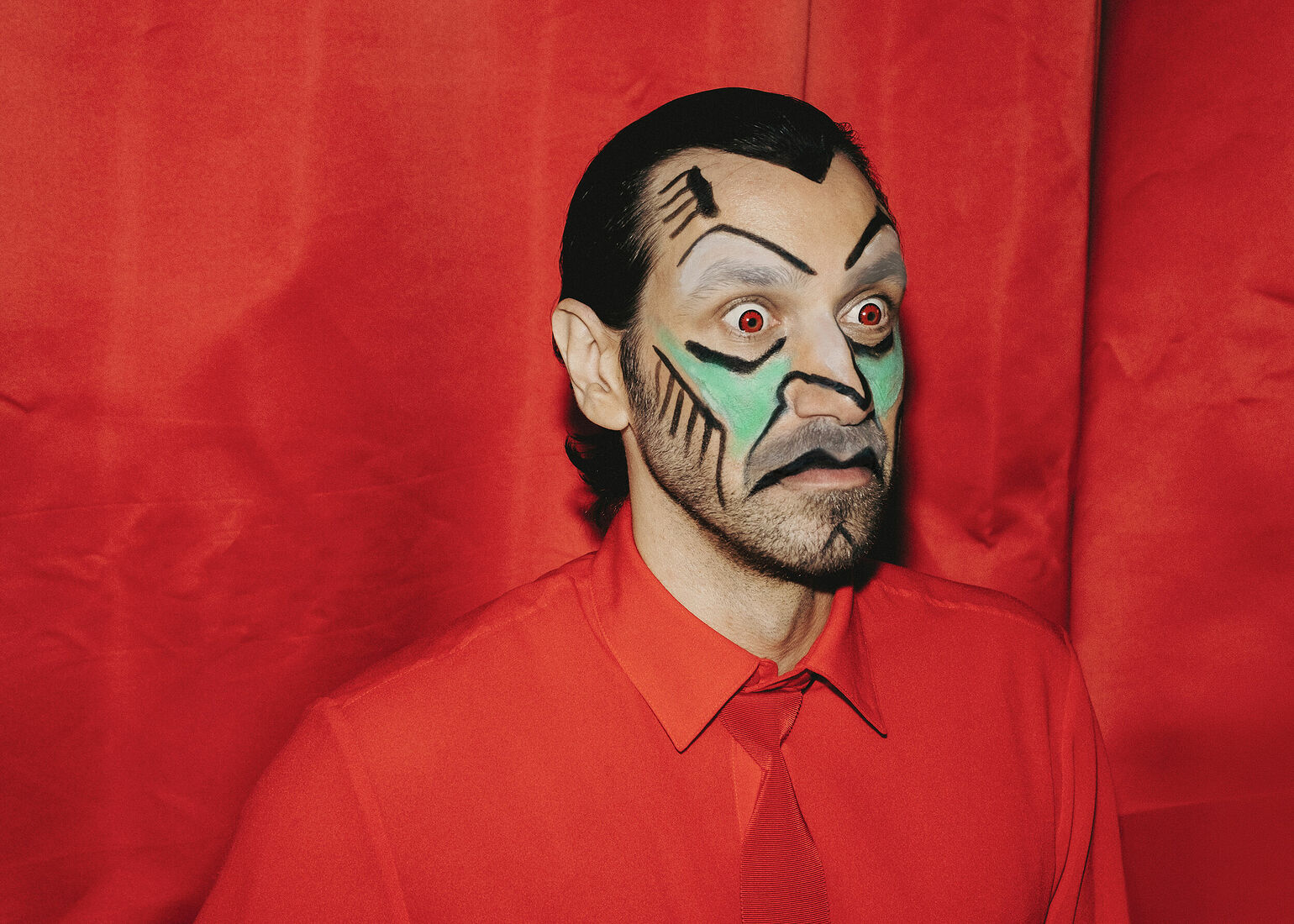
The interview was conducted exclusively for the publication Dom Hedonizma. Photo by Alina Utrobina.